Hubble and JWST Reveal a Stunning Einstein Ring
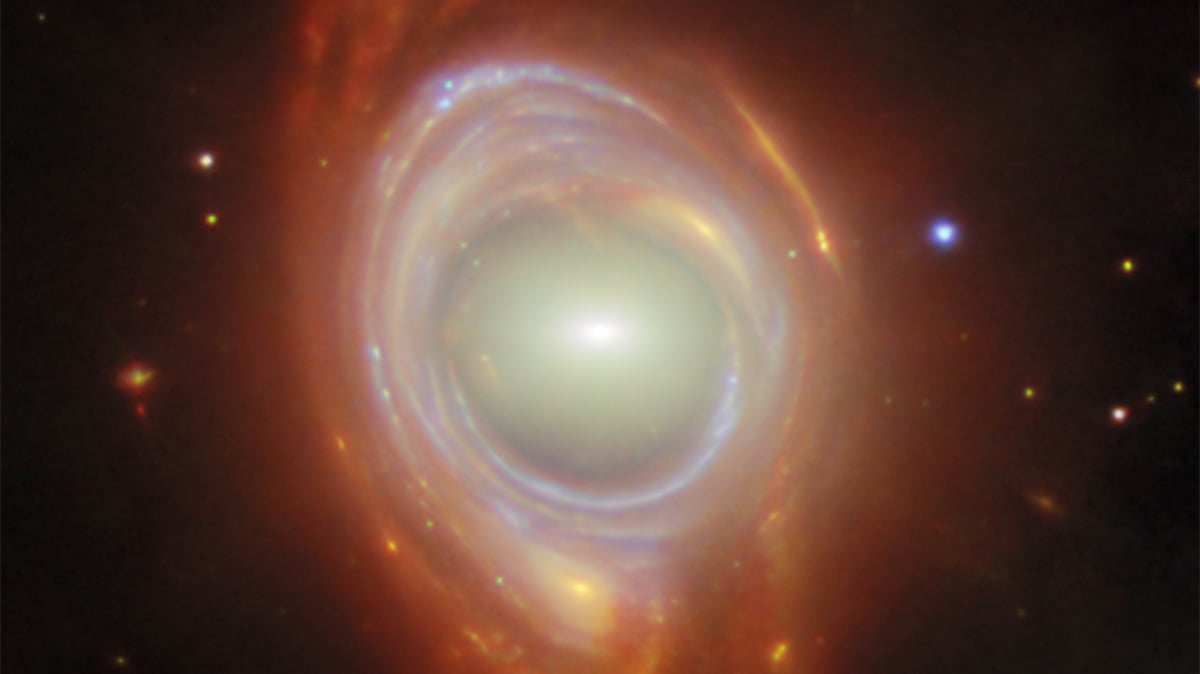
In a beautiful blend of science and serendipity, astronomers using the Hubble Space Telescope and the James Webb Space Telescope (JWST) have uncovered a striking Einstein ring. This newly released image, named SCI25004a, captures a distant spiral galaxy wrapped into an almost perfect circle by the immense gravity of a foreground elliptical galaxy. The image is not just visually stunning, it’s also a scientific treasure. It tells us about the nature of gravity, dark matter, and distant galaxies. Let’s dive into this cosmic masterpiece.
What the image shows
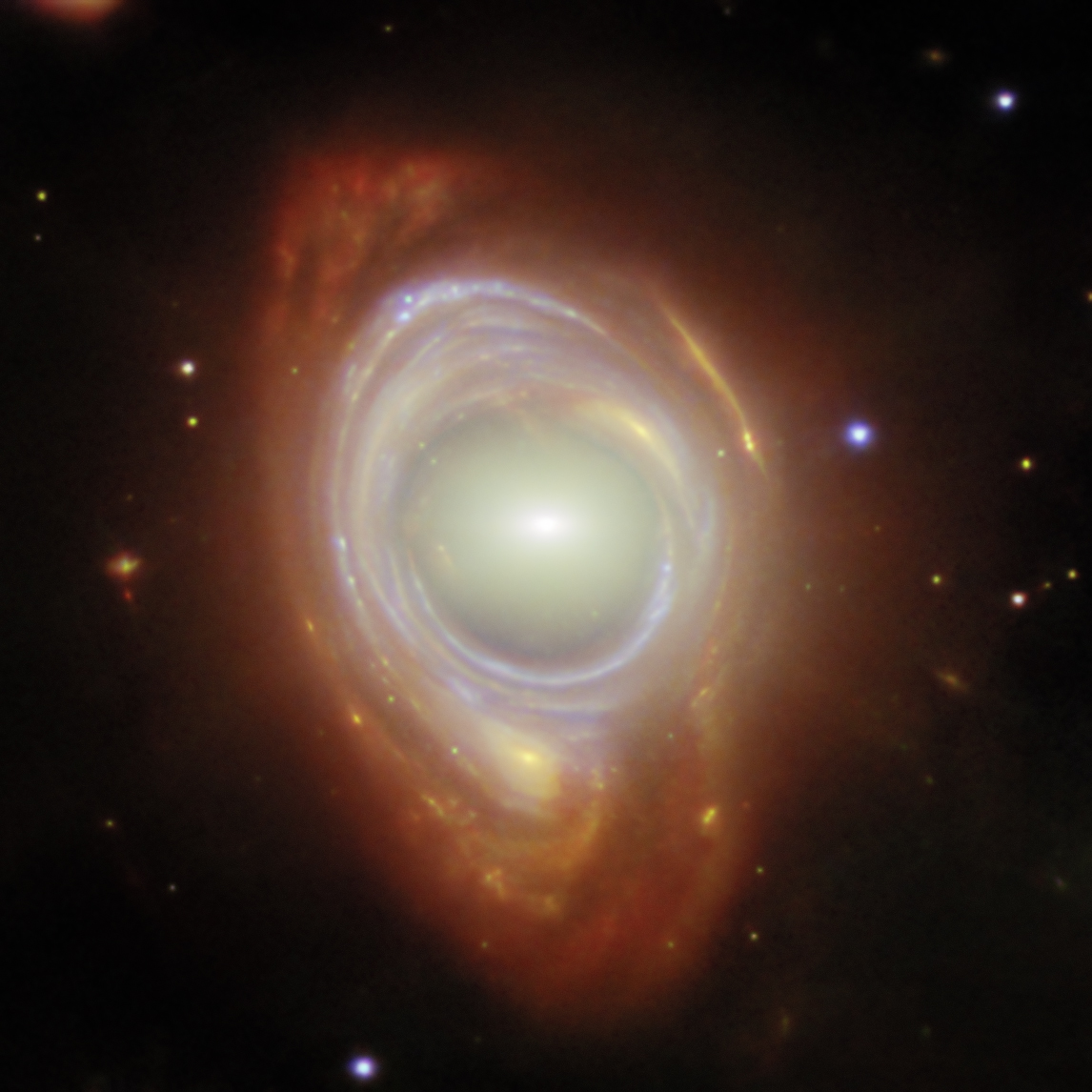
The image showcases one of the best examples of an Einstein ring ever seen. At the center sits a massive elliptical galaxy. This galaxy acts as a lens, warping space-time with its gravity. Behind it, almost perfectly aligned, lies a distant spiral galaxy. The light from this background galaxy bends around the foreground one, forming a near-complete circle of light. This circular arc is known as an Einstein ring, a rare cosmic phenomenon predicted by Albert Einstein’s theory of general relativity. The alignment must be incredibly precise. Only then does the light stretch into such a complete ring. These events are more than beautiful; they offer valuable scientific insights.
Gravitational lensing
The key concept behind this image is gravitational lensing. It happens when a massive object, like a galaxy or a cluster, bends the path of light traveling from a more distant object. Gravity acts like a cosmic magnifying glass. In this case, the massive elliptical galaxy lies in a cluster known as SMACS J0028.2-7637. This foreground galaxy is so heavy that it distorts the space around it. Light from the background spiral galaxy, much farther away, takes multiple curved paths around the foreground galaxy to reach us. This warping produces the blue, arc-shaped features you see in the image. These arcs are multiple images of the same distant spiral galaxy. In this instance, they line up to form a ring. The clarity and completeness of the ring are exceptionally rare.
Hubble and JWST working together
This stunning view is a result of a combined effort by Hubble and JWST. Hubble provided high-resolution optical data using its Advanced Camera for Surveys (ACS) and Wide Field Camera 3 (WFC3). These instruments captured the intricate structure of the foreground galaxy.
Meanwhile, the James JWST Space Telescope’s Near Infrared Camera (NIRCam) added deep infrared imaging. JWST’s infrared view penetrates dust and reveals features invisible in optical wavelengths. Together, they produced this richly detailed image. The combination also helps astronomers better understand the physics behind both galaxies.
Exploring the background spiral galaxy
Thanks to lensing, the distant spiral galaxy appears much larger and brighter than it would normally. Its light comes from billions of light-years away. That means we are seeing it as it was long ago, perhaps just a few billion years after the Big Bang. This allows scientists to study the structure, star formation, and evolution of galaxies in the early universe. Spiral galaxies are of particular interest. They help explain how galaxies like our own Milky Way came to be. In this case, the spiral arms show up clearly as blue arcs. Blue light usually means young, hot stars. So, we know that this galaxy is actively forming stars. The color and brightness of different parts of the ring reveal how star formation is happening across the galaxy.
The image is a cosmic alignment frozen in light, stretched by gravity, and captured by two of the most powerful space telescopes ever built. It teaches us about dark matter, galaxy evolution, and the vast structures of the universe. But beyond the science, it also inspires awe. It reminds us of the beauty and mystery of the universe. And it shows what we can achieve when human curiosity meets powerful technology.
Clear skies!