Measuring the Sky Brightness: Unihedron’s Sky Quality Meter
The night sky is disappearing. Light pollution is spreading fast. Cities glow, and stars vanish. But how do we measure this loss? How can we record the darkness of the night sky? That’s where the Sky Quality Meter (SQM) steps in. This compact device from Unihedron allows anyone to measure night sky brightness accurately. Whether you’re a professional astronomer or a backyard stargazer, the SQM helps you understand your sky.
What is a Sky Quality Meter?
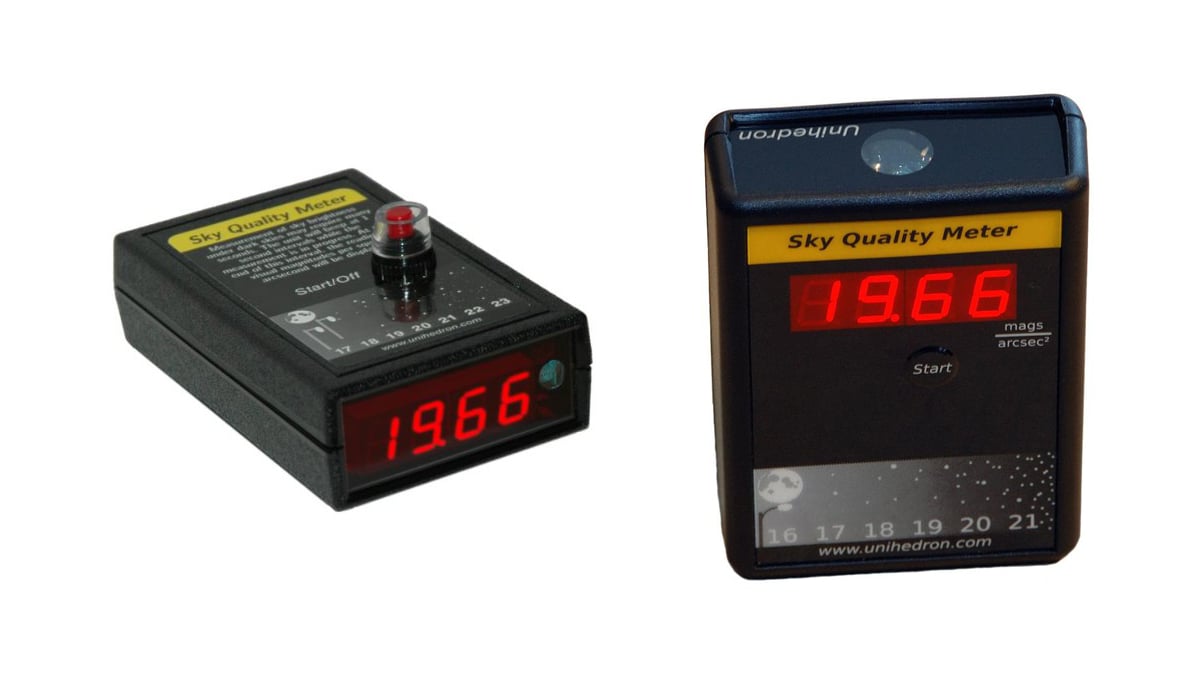
The Sky Quality Meter is a light measurement tool. It shows how dark or bright the night sky is. It gives a number in magnitudes per square arcsecond (mag/arcsec²). This number tells you how much light is in the sky. A higher number means a darker sky. A lower number means more light pollution. The device is small and portable. It fits in one hand. It runs on a battery and has a digital display. You point it toward the sky, press a button, and it gives you a reading in seconds.

How does it work?
The SQM contains a light sensor. It measures the amount of visible light in a specific part of the sky. The sensor mimics the sensitivity of the human eye. The device uses this data to calculate sky brightness. It converts the value into mag/arcsec². For example:
- 22.0 = very dark sky (no light pollution)
- 21.0 = rural area (slight pollution)
- 20.0 = small town (moderate pollution)
- 18.0 = city edge (high pollution)
- 16.0 or less = city center (severe pollution)
This scale is logarithmic. A change of 1.0 means a 2.5 times difference in brightness. Even small changes in value matter.

How to use the SQM
Using the SQM is easy. Here’s a basic step-by-step:
- Go outside on a clear, moonless night.
- Let the device adjust to the temperature for 10–15 minutes.
- Point it straight up (toward the zenith).
- Press the button.
- Read the value on the display.
- Record the time, date, location, and weather.
Avoid pointing it near the Moon, clouds, or bright stars. These can affect accuracy.

Different models of SQM
Unihedron makes several versions of the SQM. Each has a slightly different use.
- SQM (Original): Wide field of view (approx. 80°), best for general measurements
- SQM-L (Lens Model): Narrow field of view (approx. 20°), more precise readings, ideal for consistent tracking
- SQM-LU (USB): Connects to a computer, for automated measurements, used in observatories and weather stations
- SQM-LR: Connects to a network, for automated measurements
- SQM-LE (Ethernet): Connects to network systems, ideal for remote monitoring
- SQM-LU-DL: Has internal data logging, stores readings for later analysis
All models give similar brightness readings. The choice depends on your need: manual use, automation, or precision.

Who is it for?
The SQM offers many benefits for a wide range of usage.
- For Astronomers: It helps them monitor observing conditions. It provides hard data, not just guesses. It also lets them compare nights over time.
- For Astrophotographers: It helps plan shoots. They can check the sky quality before taking long exposures. It helps them pick the best locations.
- For Scientists: They use it in long-term light pollution studies. It helps track changes in sky brightness over months or years.
- For Dark-Sky Parks: Many protected areas use SQMs to prove their darkness. This supports IDA (International Dark-Sky Association) certifications.
- For Cities and Policymakers: It helps assess how street lighting affects the night sky. Some use it to support better lighting laws.

Price and availability
Sky Quality Meter is available for purchase from Unihedron’s official website.

The Sky Quality Meter is a scientific tool that empowers anyone to monitor the night sky. It has shaped how we understand and fight light pollution. From stargazers to scientists, the SQM has become a quiet hero of the dark. So the next time you look up, ask yourself: how dark is your sky? Then take a reading and be part of the global effort to preserve the stars.
Clear skies!