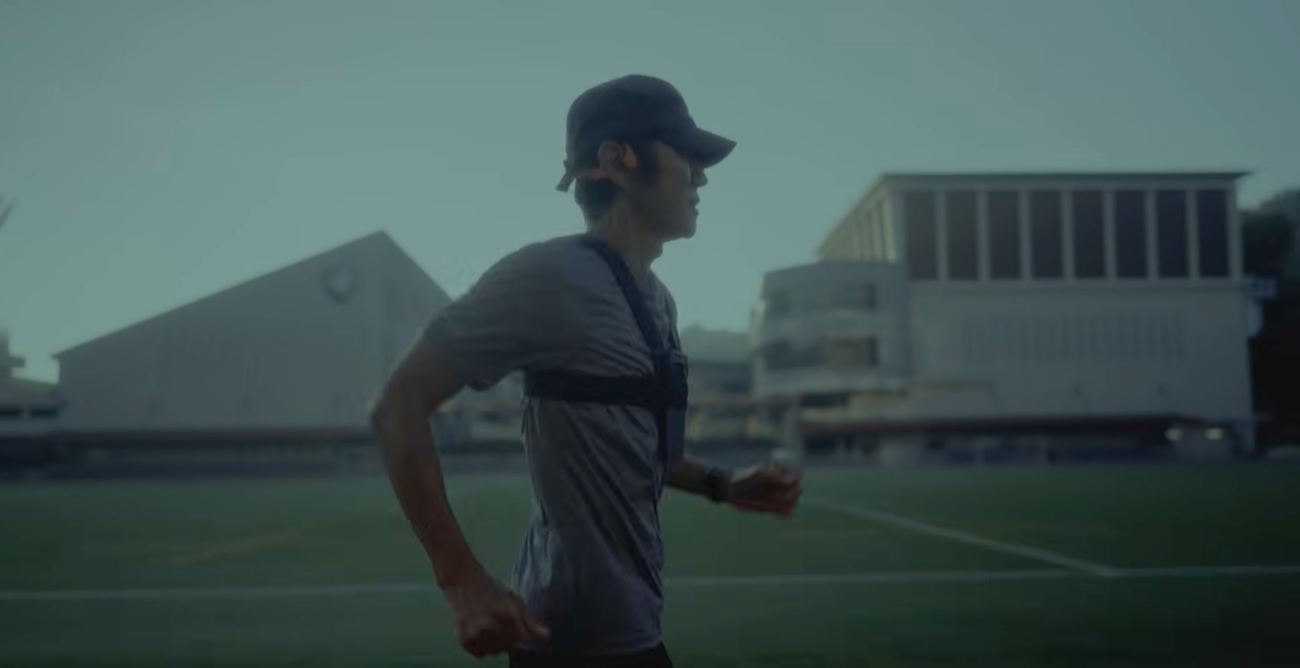
Running Guide agent helps blind and low-vision runners
For blind and low-vision (BLV) athletes, running has traditionally required a physical tether — whether it’s a human guide or a painted track line. Today, we are excited to share how we’re taking steps towards changing that with the Running Guide agent, an accessibility agent that uses real-time environmental understanding to help low-vision athletes run. It marks a massive leap from simple path-following to advanced, real-time spatial reasoning. As we work to perfect this technology, our goal is simple: unassisted independence for every runner.
A hybrid architecture for uncompromising safety
Building on our previous work with Project Guideline, the Running Guide agent uses a chest-mounted Pixel 10 Pro smartphone to view the path ahead and guide the user via auditory feedback. Because high-speed activities demand high trust, we built a hybrid, dual-path architecture:
- On-device segmentation: Running entirely offline on the Pixel 10’s custom silicon, this model guarantees ultra-low latency safety. It delivers immediate “STOP” alerts and steering cues — heard as directional ticking sounds — so runners maintain a reliable sense of direction even without a cellular connection.
- Gemma 4’s advanced reasoning: Leveraging Gemma 4 E4B, this path handles complex multimodal inputs (image and text) for high-level scene understanding entirely on device. To keep latency low, we use Smarter Frame Selection. Instead of processing every frame, the model only analyzes “high-entropy” frames — like sudden terrain changes or new obstacles — delivering faster, highly relevant coaching.